Thursday, November 8, 2012

Sentences from Class


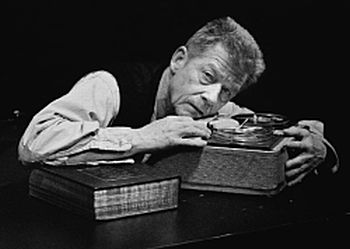
Light is a constant theme, yet he lives in a world of darkness.

Memories slip away, but will forever be on tape.

The old man yearns for his former lover.

While the tape machine replays his life, Krapp reminisces about his time on this muckball.

Each spool contains a brief moment of Krapp's existence. 

Wednesday, October 31, 2012

Aww Krapp!

(http://groovysweet.wordpress.com/tag/fried-bananas-webcomic/page/4/)

          Krapp's Last Tape is definitely up there on my list of favorite Beckett plays to watch. It amazes me that a ten page script can be turned into a production that is almost an hour long. It just proves that sometimes stage directions are just as important (if not even more important) than what the actors actually say. As an actress myself this is something that I have come to know very well. 

          I remember the first time that one of my high school acting friends told me about the play Krapp's Last Tape. The first thing she said was. "It's just this old guy listening to prerecorded tapes of himself talking, and then he eats some bananas." My first thought was, "Well that has to be one of the easiest roles that an actor could ever play. Hardly any lines to memorize, and you get to sit around and eat." Boy was I wrong. In fact, Krapp is probably one of the more difficult roles that an actor could ever play. As we saw in the film, timing is everything. An actor must learn how to properly use silence in a scene. This may sound like a funny idea, but it is actually really important. If a pause is too long it will feel awkward to the audience. However, if a pause is too short, then it may not give the audience time to process the silence and note the meaning behind it. In a play that is as stage direction heavy as this one, it is also important for the actor to pay close attention to every direction and find the meaning behind it. You may have heard actors in sitcoms jokingly say, "What's my motivation?" before. Well in this case that is a serious question that the actor must consider. If an actor does not figure out the character's reasoning behind his actions, then the ten page script will either produce a ten minute play, or a long and boring play where a man just walks around and does stuff. 

          Beckett was always very particular about the way that his plays were put on, and I believe he had a good reason to be like that. It is because there is so much meaning to be found where there are no words to convey it. If the blocking and timing are not perfect, then meaning is lost. It is amazing how much the way that a man eats a banana can tell you about him. I believe that Beckett knew this, and it is one of the things that makes his plays so intriguing to me. 

Endgame

(Sorry this is so late. I just realized that I never published it.)


          After watching Endgame in class I was filled with ideas, so I'm sorry if this post is a bit scattered. However, I find that this feeling is common after I watch a Beckett play. 

          One of my favorite passages from Endgame can be found on page 96:

                              Hamm: Sit on him
                       Clov: I can't sit
                       Hamm: True. And I can't stand.
                       Clov: So it is.
                       Hamm: Every man his speciality.

          What I love about this passage is that Beckett takes a situation that really isn't that funny, and he plays up the humor of it. If you look at the situation closely, you see two men living in a horrible situation. They live in a small space in a post-apocalyptic world. The elderly are kept in garbage cans, and the descriptions we hear of the world outside seem pretty grim. It is definitely not a world that I would want to live in. The two men also have physical disabilities that would surely make their lives even more difficult than they already are. However, this passage makes you momentarily forget how terrible this life would be by making the situation actually seem comical. Instead of lamenting about how horrible it is that they have these disabilities the two men make light of it. Hamm says. "Every man his speciality," as if sitting and standing are skills that only a few people possess. This section also reminded me of a quote about life:

"Life is a tragedy when seen in close-up, but a comedy in long-shot."
-Charles Chaplin

          One of the other parts that stood out to me starts on page 99:

                          Nagg: Can you see me?
                    Nell: Hardly. And You?
                    Nagg: What?
                    Nell: Can you see me?
                    Nagg: Hardly.
                    Nell: So much the better, so much the better.
                    Nagg: Don't say that. 
                          [Pause.]
                          Our sight has failed.
                    Nell: Yes.

          This passage stood out to me for two reasons. The first is that I noticed the same type of repetition that was common in Waiting for Godot. One character would say something, and then the other character would repeat it word for word a few lines later. It also stood out to me, because it reminded me of a sketch done by one of my favorite comedians. The comedian is Hal Sparks, and I will leave you with a video of it: 

(The bit that I am talking about begins at about 2:20)

Sunday, October 14, 2012

Life Goes On

"Two Men Contemplating the Moon" By: Caspar David Friedrich

          Waiting for Godot has always held a special place in my heart. Not only was it the first Beckett work that I ever read, but it was also the first Theatre of the Absurd piece that I ever saw live. After that I was hooked. I think what drew me in the most was the simplicity of the piece. Most shows have so many characters that you need a list to keep up with them all. This is not the case in Waiting for Godot. It doesn't have any excess fluff either. Every word is there for a reason. It is not a show that most people would go see for an evening of lighthearted entertainment. Instead it makes you think.

          However, Waiting for Godot is not lacking in humor. You don't even have to look that hard for it. You can find plenty of examples of slapstick comedy throughout the show. My favorite example is right near the end of the play. The two men are contemplating suicide, but they don't have anything to hang themselves with. Then they realize that Estragon is wearing a belt. The stage directions say, "Estragon loosens the cord that holds up his trousers which, much too big for him, fall about his ankles. They look at the cord." This moment is not only a perfect example of slapstick comedy, but also of the dark humor that runs throughout Beckett's work. Here are two men discussing a very serious and morbid topic, and then suddenly one of the men is in his underwear. It's a beautiful juxtaposition. What makes this moment even better is the fact that neither one of the men seems to notice or care that Estragon's pants have fallen down. Instead they just look at the cord. Life goes on whether you are wearing pants or not. Sometimes all you can do is keep moving towards the future. Even if the future is uncertain, it's how you get there that is really important.

Here is my favorite parody of Waiting for Godot:


Friday, October 12, 2012

The Unnamable

The heads in jars from Futurama 
          While reading The Unnamable I came across a passage that feels very relevant to my life right now. "Whether all grow black, or all grow bright, or all remain grey, it is grey we need, to begin with, because of what it is, and of what it can do, made of bright and black, able to shed the former, or the latter, and be the latter or the former alone" (295). This passage stood out to me, because I am living in a world of grey right now. I am just finishing up a production of the show The Giver. In this show there is no color, and the people can only see in shades of grey. This means that the set pieces, the props, and the costumes are all grey. Since we rehearse every free moment, this is the world that has taken over most of my life. I've even noticed that the show has had an impact on the way that I dress in everyday life. That's why it was a little surprising to see that grey had even worked its way into my homework.

          However, I am glad that my time spent in the world of The Giver made me pay particular attention to this passage, because it really is an interesting idea. Grey is the median between two extremes. It is flexible and adaptable. It can be whatever it needs to be or wants to be.

Today I'll leave you with some of my other favorite talking heads:
Dorium Maldovar from Doctor Who
Jambi the Genie from Pee-Wee's Playhouse
The Talking Heads

Monday, September 17, 2012

Death in Beckett


            After reading Malone Dies, I was left with thoughts of a topic that Beckett seems to favor. The topic is death. The first sign that this novel will include death comes from the title. Malone knows he is going to die. However, there is still an uncertainty in him about when. “I shall soon be quite dead at last in spite of all. Perhaps next month. … Perhaps I am wrong, perhaps I shall survive Saint John the Baptist’s Day and even the Fourteenth of July, festival of freedom” (173). However, death does not seem to scare Malone at all. He handles the matter like it is an every day occurrence. We later find out that Malone is desensitized enough from death that he has even murdered people.

            I’ve talked about death before in this blog, but the circumstances of death are a little different in this novel than they were in “Ding-Dong.” In “Ding-Dong” the child’s death is an accident. Since it was accidental I can see how some people may write it off as being inevitable and of little significance to them. However, in Malone Dies Malone talks about how he murdered people with no sign of remorse. To me this is a whole new level of apathy. He seems to have no regard for human life. Perhaps that is why he could not care less about his own death.

            While I am not looking forward to death, I do know that it is inevitable. Nobody can live forever, and honestly nobody should live forever. There are many reasons why immortality would not be a good thing, and here is a comic by one of my favorite webcomics illustrating one of these reasons.


Monday, September 10, 2012

Molloy


          One of my favorite things about reading a Beckett novel is that you can always find comedy if you look for it. No matter how melancholy the subject, there is always something hidden in the text that can make you laugh. An example of this can be found on page 13 of Molloy. Molloy is talking about his mother, and if someone in real life were to describe their mother in the same way we would be repulsed. It would be shocking to hear someone describe the situation in such detail, and it would be shocking to learn that someone actually lives like this. However, when Molloy describes the situation it is almost humorous. This is because Beckett is a master of word choice. He knows how to take a serious subject and word it in an unexpected way. For example, “My mother never refused to see me, that is she never refused to receive me, for it was many a long day since she had seen anything at all” (13).  When I read this sentence I could not help but laugh. While I still felt bad about the mother, I could also see the humor of the situation. Beckett does this again on page 17 when Molloy is being arrested. “He listened to his subordinate’s report and then began to interrogate me in a tone which, from the point of view of civility, left increasingly to be desired, in my opinion” (17). While Beckett could have said, “The police officer yelled at me,” and had the same meaning, it would not have had the same effect. Here Beckett proves just how important word choice can be for setting the tone of a piece.

Wednesday, September 5, 2012

Reflection on Ding-Dong


          After reading the stories in More Pricks than Kicks, one passage stood out to me: It came from the work “Ding-Dong” and can be found on page 102 of The Selected Works. In this passage Belacqua comes across a little girl who has been run over by a bus. However, rather than show any concern for the girl, Belacqua notices the state of the food she was carrying. “The good milk was all over the road and the loaf, which had sustained no injury, was sitting up against the kerb” (102). It struck me as odd that he was more concerned about the “good milk” than the girl. However, the story of the girl is not over yet. There were also spectators who were waiting in line for a movie. “The queue standing for the Palace Cinema was torn between conflicting desires to keep their places and to see the excitement” (102). Yet there is still no concern for the person harmed. The movie goers seem to only be worried about satisfying their thirst for entertainment. Whether it is making it into the movie or seeing live excitement, they could care less about the person who was harmed. I read on, and I saw one last hope that someone might help the girl. Another girl stepped out of the line. However, her intentions were not with the dead person in mind. “Only one girl, debauched in appearance and swathed in a black blanket, fell out near the sting of the queue and secured the loaf” (103). Once again the unaffected person was only concerned with her own needs.

          My original explanation of the nonchalant attitudes held by the bystanders was that they only cared about themselves. However, when I looked again, I came up with a different answer. From what I gathered in the text, I realized that the girl was probably beyond help at that point. Death is inevitable, so logically these people have no reason to mourn this stranger. Since she cannot be helped, they should focus on something that can be done. They can use the food to keep themselves alive. At the end of the day, life goes on, and we must do our best to get ourselves through it.

To end on a lighter note, here is a comic about death:
(www.xkcd.com/1065/)

Tuesday, August 28, 2012

Fiction vs. Memory

CECILY
I keep a diary in order to enter the wonderful secrets of my life. If I didn't write them down, I should probably forget all about them.

MISS PRISM
Memory, my dear Cecily, is the diary that we all carry about with us.

CECILY
Yes, but it usually chronicles the things that have never happened, and couldn't possibly have happened. 

(The Importance of Being Earnest)

          When I first read through “Company” I did not quite know how I wanted to interpret the events. My immediate thought was that the character in the piece was retelling his memories on his deathbed. However, the more I looked at it, the more I thought about the possibilities of it being completely different. For example, it could also be a man creating stories to amuse himself while falling asleep. Then I realized that maybe my second idea was not as completely different of an idea as I originally thought. This is because I went on to think about what I know of memories from psychology.
          The mind is a wonderful, but confusing thing. Many people believe that our memories are highly accurate (McLeod). This is why juries in court often heavily weight eyewitness testimonies. However, our memory is not really as accurate is many might think. In fact, we tend to manufacture elements of our memories all the time to make sense of them. The way human memory works is that we tend to remember the main idea of something that happened rather than a play by play. We then take this idea and shape it so that it fits with ideas that we already recognize and understand (McLeod).
          After reading up on this phenomenon, I was reminded that fiction and memory are not two entirely exclusive things. In a way all memory is fiction, because it is an individual’s own interpretation of how an event occurred. If the same event were recalled in another individual’s memory, it may have minor differences, or it may have major differences from how the first individual remembered it. It all depends on how that person perceived the event.


McLeod, S. A. (2009). Eyewitness Testimony. Retrieved from http://www.simplypsychology.org/eyewitness-testimony.html

Tuesday, August 21, 2012

Introduction and Reflection on "What Would I Do"


"No symbols where none intended" -Samuel Beckett

          I chose this quote as the title for this blog, because it is one of my favorite Beckett quotes. Samuel Beckett was a very intelligent man, and one of my favorite things to do while reading Beckett is to try and find the humor hidden in what appears to be a depressing piece.

          The name included in the URL is also a quote from Beckett. I chose it from one of the poems we looked at yesterday called "What Would I Do". I found "What Would I Do" particularly interesting due to the change in attitude that takes place quite suddenly near the end of the poem. Beckett begins this poem by talking about the world. It is not a particularly cheery outlook on life, but it is a realistic way of looking at the world. He emphasizes the fact that life is temporary, and death is inevitable. He asks, “What would I do without this world Faceless incurious where to be lasts but an instant…” While the expected answer would be “nothing,” Beckett takes a different route. His answer is, “What I did yesterday and the day before.”

          What I get from this poem is that life goes on. Human nature is unchanging, and we are all just small parts of a larger entity. While small details may change, it really does not matter in the grand scheme of things.

          The whole piece has a haunting tone. It is not a piece that makes you jump for joy to say the least. However, it is beautiful and hard to forget.